


Mandragora officinarum is the type species of the plant genus Mandragora. It is often known as mandrake, although this name is also used for other plants. As of 2015, sources differed significantly in the species they use for Mandragora
Mandragora officinarum is the type species of the plant genus Mandragora. It is often known as mandrake, although this name is also used for other plants. As of 2015, sources differed significantly in the species they use for Mandragora plants native to the Mediterranean region. The main species found around the Mediterranean is called Mandragora autumnalis, the autumn mandrake. In a broader circumscription, all the plants native to the regions around the Mediterranean Sea are placed in M. officinarum, which thus includes M. autumnalis. The names autumn mandrake and Mediterranean mandrake are then used.[2] Whatever the circumscription, Mandragora officinarum is a perennial herbaceous plant with ovate leaves arranged in a rosette, a thick upright root, often branched, and bell-shaped flowers followed by yellow or orange berries.
Because mandrakes contain deliriant hallucinogenic tropane alkaloids and the shape of their roots often resembles human figures, they have been associated with a variety of superstitious practices throughout history. They have long been used in magic rituals, today also in contemporary pagan practices such as Wicca and Heathenry.[3] However, the so-called "mandrakes" used in this way are not always species of Mandragora let alone Mandragora officinarum; for example, Bryonia alba, the English mandrake, is explicitly mentioned in some sources.
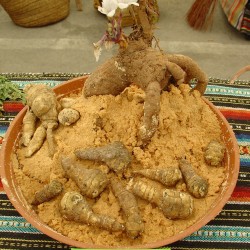
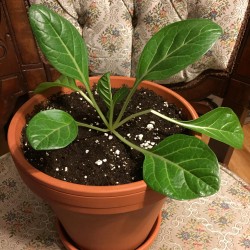
As of 2015, Mandragora officinarum has three or four different circumscriptions (see Taxonomy below). The description below applies to a broad circumscription, used in a 1998 revision of the genus, in which the name is used for all the plants native to Mediterranean region.[1] Thus defined, Mandragora officinarum is a very variable perennial herbaceous plant with a long thick root, often branched. It has almost no stem, the leaves being borne in a basal rosette. The leaves are very variable in size and shape, with a maximum length of 45 cm (18 in). They are usually either elliptical in shape or wider towards the end (obovate), with varying degrees of hairiness.[1]
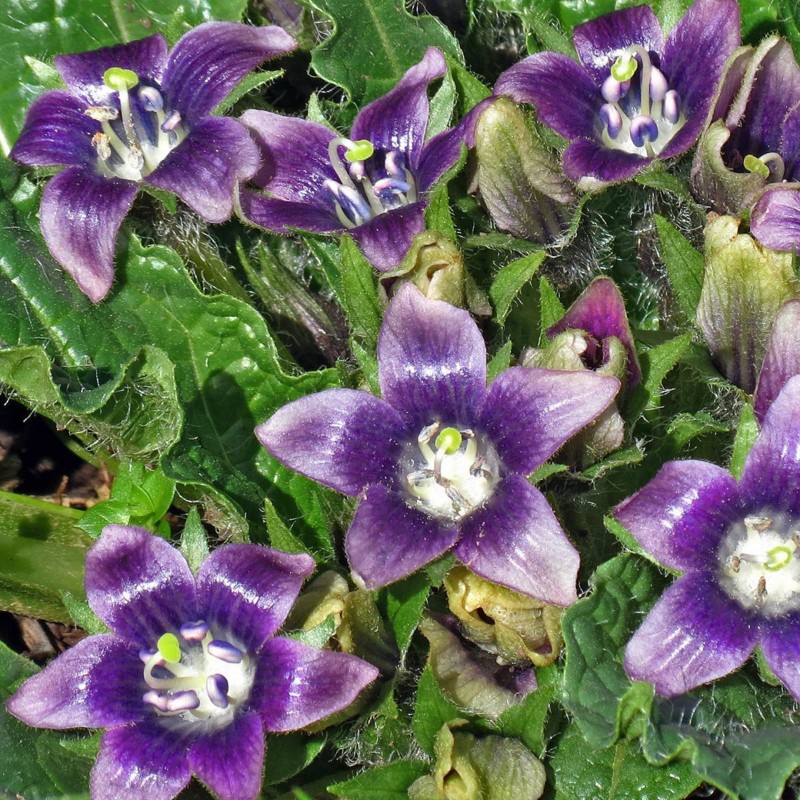
The flowers appear from autumn to spring (September to April). They are borne in the axils of the leaves. The flower stalks (pedicels) are also very variable in length, up to 45 cm (18 in) long. The five sepals are 6–28 mm (0.2–1.1 in) long, fused together at the base and then forming free lobes to about a half to two-thirds of their total length. The five petals are greenish white to pale blue or violet in colour, 12–65 mm (0.5–2.6 in) long, and, like the sepals, joined together at the base with free lobes at the end. The lobes are between half as long as the petals to almost as long. The five stamens are joined to the bases of the petals and vary in length from 7 to 15 mm (0.3 to 0.6 in). The anthers of the stamens are usually yellow or brown, but are sometimes pale blue.[1]
The fruit which forms in late autumn to early summer (November to June) is a berry, shaped like a globe or an ellipsoid (i.e. longer than wide), with a very variable diameter of 5–40 mm (0.2–1.6 in). When ripe, the fruit is glossy, and yellow to orange – somewhat resembling a small tomato. It contains yellow to light brown seeds, 2.5–6 mm (0.10–0.24 in) long.[1]
Earlier, a different circumscription was used, in which Mandragora officinarum referred only to plants found in northern Italy and part of the coast of former Yugoslavia, most Mediterranean mandrakes being placed in Mandragora autumnalis.[4][5] The description above would then apply to both species combined, with M. officinarum having greenish-white rather than violet petals, up to 25 mm (1 in) long rather than usually 30–40 mm (1.2–1.6 in) or longer, and a berry that is globose rather than ellipsoid.[4] More recently, plants native to the Levant have been separated out as Mandragora autumnalis, leaving those found in the rest of the Mediterranean area as M. officinarum. One difference then is that the size of the seeds of M. officinarum is less than half the size of those of M. autumnalis.

Mandrake has a long history of medicinal use, although superstition has played a large part in the uses to which it has been applied.[14] WebMD, which categorises the herb European Mandrake derived from Mandragora officinarum under the heading "Vitamins & Supplements", declares that it is UNSAFE for anyone to use European mandrake for medicinal purposes.[15] In the UK, The Prescription Only Medicines (Human Use) Order 1997, in its Schedule 1,[16] identifies "Mandragora autumnalis" as a substance which, if included in medicinal products, makes those products prescription only medicines, and therefore only prescribable by those categories of appropriate practitioners specified in Regulation 214 of The Human Medicines Regulations 2012.[17] Medical herbalists are not recognised as "appropriate practitioners" under this legislation. Mandragora autumnalis Bertol.[18] is currently an accepted species distinguishable from Mandragora officinarum L.,[19], so it follows that mandrake preparations and products derived from Mandragora officinarum L. may not actually be covered by this UK legislation. However, the European Medicines Agency, which oversees the registration of herbal medicinal products in the European Union, does not recognise mandrake, and indeed any Mandragora species, as an approved herbal medicinal product, substance, or preparation under the European Directive on Traditional Herbal Medicinal Products.[20]
The root is hallucinogenic and narcotic. In sufficient quantities, it induces a state of unconsciousness and was used as an anaesthetic for surgery in ancient times.[21] In the past, juice from the finely grated root was applied externally to relieve rheumatic pains.[21] It was also used internally to treat melancholy, convulsions, and mania.[21] When taken internally in large doses, however, it is said to excite delirium and madness.[21]
In the past, mandrake was often made into amulets which were believed to bring good fortune and cure sterility. In one superstition, people who pull up this root will be condemned to hell, and the mandrake root would scream as it was pulled from the ground, killing anyone who heard it.[3] Therefore, in the past, people have tied the roots to the bodies of animals and then used these animals to pull the roots from the soil.
Data sheet

Mandragora officinarum is the type species of the plant genus Mandragora. It is often known as mandrake, although this name is also used for other plants. As of 2015, sources differed significantly in the species they use for Mandragora